














 Cloud Login

// vehicle-bus logging
AutoPi CAN-FD Pro
Start here for J1939, CAN FD and vehicle-bus data logging. Confirm the vehicle network, connector and signal definitions.
Explore CAN-FD ProAutoPi collects CAN/J1939, OBD-II, GPS and environmental sensor data from tractors, trailers and reefers. Devices run at the edge, buffer when offline, and sync to the cloud over secure channels. You define loggers, thresholds and actions; the platform records events, creates alerts, and exposes data through APIs and exports.
Agree on the required signals, sampling rates, trip detection and geofences for depots and customer sites. Validate data availability and decoding by OEM, model and year. A vehicle connector alone does not guarantee access to every requested parameter.
The system supports multiple network protocols including CAN-FD, J1939, ISO 14229 (UDS) and ISO 15765. Data from these channels can be combined with GPS and accelerometer data to build a continuous timeline of vehicle performance, cargo conditions and driver activity. Each message is timestamped at the source, enabling sub-second event correlation across vehicles in the fleet.
Data is stored locally on the device when cellular connectivity is unavailable, ensuring zero data loss during coverage gaps. Once reconnected, buffered data is transmitted using a compressed and signed protocol. This guarantees delivery integrity even for large fleets operating across regions with limited coverage. Transport encryption and per-device authentication prevent tampering or injection of unauthorized data.
The platform can integrate directly with existing systems via REST, MQTT, or webhook-based APIs. Users can export telemetry to fleet management software, maintenance systems, or analytics pipelines. Real-time alerts, diagnostics and firmware updates can all be automated through rule-based jobs and OTA templates, minimizing manual intervention while maintaining full operational control.
Discuss a trucking PoC
Truck Performance Monitoring
Capture available engine and powertrain metrics from CAN/J1939. Configure sampling and thresholds for validated signals such as coolant temperature or battery voltage. Maintenance-system work orders require integration with your existing workflow.

Cargo Monitoring
Log temperature, humidity, door state and shock for each load. Set per-lane or customer thresholds and receive excursions in real time. Generate shipment PDFs or JSON exports with sensor traces, setpoints, and handling notes for audit and claims.

Driver Behavior Analysis
Derive events for harsh acceleration/braking, overspeed and idling. Map drivers via RFID/Bluetooth or assignment. Produce adherence metrics per driver, lane and vehicle class. Optionally feed coaching systems through webhooks.

Trip and Geofence Monitoring
Configure geofences for depots and customer sites, review trips and monitor entry, exit and dwell time. Use the resulting data in your TMS or BI integration. Route planning and optimization require a separate routing engine or integration.
Devices read vehicle networks (CAN, CAN-FD, J1939, ISO 15765) and GPS at configurable intervals. Edge filters reduce bandwidth by aggregating and compressing non-critical signals while retaining full-rate data for thresholds and faults. When connectivity drops, data buffers locally and syncs on reconnection.
Fleet configuration is template-driven: loggers, triggers, jobs and returners are versioned and applied per OEM/model year. OTA updates support staged rollout and rollback. Every change is stored with author, timestamp and diff for audit.
Typical triggers include repeated DTCs over a window, temperature gradients exceeding a slope, voltage sag during crank, and coolant/oil threshold crossings. Each trigger can execute a job (diagnostic capture, service command) and emit notifications to email, webhook or MQTT with deduplication and retry policies.


Pair tractors and trailers automatically and log custody events. For cargo, define limits per load and record excursions with sensor traces and GPS. For drivers, aggregate behavior events and correlate with fuel and maintenance outcomes. Reports can be scheduled to PDF/CSV or delivered as JSON to downstream systems.
Access is controlled by roles and nested accounts. Data access follows tenant boundaries. All actions (command execution, config changes, firmware pushes) are logged with device ID, user, and result code.
Integration options include REST pull, MQTT topics with QoS and retained messages, and webhook callbacks with signed requests. For bulk analytics, scheduled exports provide partitioned files by day, vehicle group or customer, suitable for data lake ingestion.
trip_end. Rules can be staged on a subset of vehicles and rolled out fleet-wide after validation. Actions include diagnostic capture, webhook to TMS, or placing the vehicle into a maintenance state with notifications to a defined channel.
// built around your industry
Let's match your vehicles and data requirements to the right hardware, then explore your integration together. AutoPi Cloud is included with every AutoPi device.
// vehicle-bus logging
Start here for J1939, CAN FD and vehicle-bus data logging. Confirm the vehicle network, connector and signal definitions.
Explore CAN-FD Pro// fleet data
For supported EV and OBD fleet data. Check make, model, year and required parameters before ordering.
Check Mini compatibility// custom edge software
For Docker workloads and custom edge software. Confirm interfaces and any additional hardware needed.
Explore TMU CM4// delivery scope
// your proof of concept
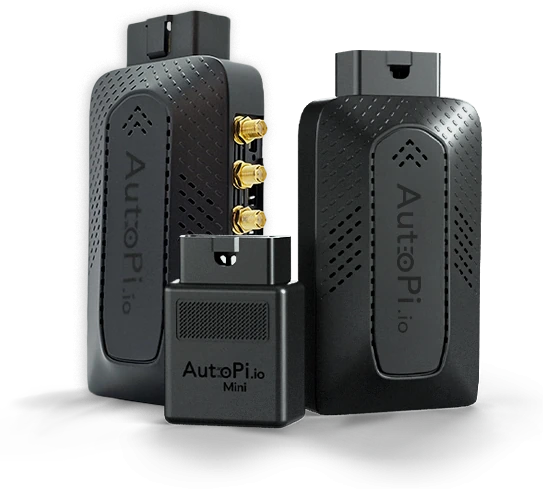
We'll help you choose devices to purchase for representative vehicles, then work with you to extract the required data, including reverse engineering where needed. Together, we'll agree the signals, installation, integration work and acceptance criteria before expanding the deployment. Feasibility and scope depend on your vehicles.
Discuss your PoCGet in touch with us - we're ready to answer any and all questions.