

















--> Innovative Vehicle Management for Public Transportation
Industry Solution

Telematics for
Public Transit Fleets

AutoPi connects buses, trams, and rail vehicles via CAN, CAN-FD, J1939, and auxiliary I/O - capturing propulsion, HVAC, doors, battery, and brake data in real time. Every vehicle becomes a traceable data node streaming status, faults, and location to your CAD/AVL, ETA, and BI systems.

1–10 s PID polling GTFS-Realtime output Offline buffering J1939 / CAN-FD
Get in touch
Transit fleet telemetry and geofencing
GTFS-Realtime live
OTP monitoring
Real-time GPS
CAN / J1939 / UDS
GTFS-Realtime
E-bus battery
OTA fleet updates
REST / MQTT export
Data pipeline

From vehicle network to agency platforms

A three-stage pipeline captures, normalizes, and delivers transit data - with every step versioned, auditable, and configurable per OEM template.

01

Capture

Periodic PID/UDS polling (1–10 s) on CAN, CAN-FD, and J1939 buses. Burst mode engages on DTC events or threshold breach. GPS and IMU overlay provide time-aligned spatial data.

CAN / CAN-FD J1939 UDS / OBD-II GPS + IMU
02

Process

OEM-specific parser templates decode raw frames. Offline buffer ensures no data loss in tunnels or low-coverage corridors. Signals are time-aligned and compressed before upload.

OEM templates Offline buffer TLS + signed
03

Deliver

GTFS-RT feeds, REST/MQTT streams, and scheduled CSV/JSON/PDF exports reach CAD/AVL, ETA, APC, and BI systems. Every export is task-logged with retention controls.

GTFS-RT REST / MQTT Webhooks CSV / JSON

Headway & dwell analysis

GPS + stop geofences compute on-time performance, bunching, and dwell per stop - alerts feed dispatch for real-time re-spacing.

Fault triage & DTC alerts

DTC events trigger burst capture and automatic tickets. Ramp, door, HVAC, and brake faults are geolocated and stamped for rapid maintenance dispatch.

E-bus energy tracking

SoC, SoH, charge sessions, and kWh/km - segmented by route, weather, and load - inform range planning and depot charging schedules.

OTA & config versioning

Fleet templates track parsers, jobs, and triggers per OEM. Staged rollout with canary groups and one-click rollback. Every change is authored, diffed, and logged.

Operations

Real-time monitoring for on-time, reliable service

  • Live headway and dwell computation with stop-level OTP dashboards and early/late status per block
  • Threshold rules for temperature, air pressure, HVAC output, and door fault - each alert includes timestamp, location, and sensor trace
  • Offline buffering for tunnels and low-coverage corridors - automatic sync on reconnect with verified, gap-free records
  • Scheduled OTP, dwell, and headway reports - daily exports by route, garage, or service day for planners and operations teams
Public metro transportation
Transit bus on route
Standards & data exchange

Interoperable feeds for CAD/AVL, rider info, and BI

  • GTFS-Realtime feeds for TripUpdates, VehiclePositions, and ServiceAlerts - partitioned by route, block, or depot
  • SIRI/ITxPT structure mapping for European deployments with full APC and fare system correlation
  • E-bus metrics - battery SoC/SoH, kWh/km, range efficiency, and charge session logs - normalized for route-level analytics
  • REST, MQTT, webhooks, and scheduled CSV/JSON/PDF exports with task IDs and retention controls for governance
Integrations

Connect with your existing transit ecosystem

Purpose-built connectors and open APIs reach every layer of your transit technology stack.

GTFS-Realtime

Full support for TripUpdates, VehiclePositions, and ServiceAlerts partitioned by route, block, or depot - ready for passenger info displays and app integrations.

CAD / AVL systems

REST and MQTT streams feed Computer-Aided Dispatch and Automatic Vehicle Location platforms with live positions, headway, and incident data for dispatcher situational awareness.

APC & fare systems

Correlate automatic passenger counts and fare events with dwell times and headway to support planning, block adjustments, and revenue analytics across routes and garages.

SIRI / ITxPT

Map telemetry to SIRI and ITxPT structures for European deployments. Feeds integrate directly with national transit data hubs and passenger information frameworks.

BI & data lakes

Scheduled CSV/JSON/PDF exports partitioned by route, garage, or service day - with task IDs, timestamps, and retention controls - flow directly into agency data warehouses and BI tools.

Ready to connect?

Talk to our transit telematics team about pilot rollout, OEM templates, and agency-specific requirements.

Get in touch
Something unclear?

Frequently asked questions

Answers about transit telematics, GTFS-Realtime, headway and dwell analytics, diagnostics, e-bus energy, integrations, and data security.

Bus, shuttle, BRT, tram, and rail fleets. Each vehicle exposes telemetry (GPS, speed, dwell), diagnostics (CAN/J1939/UDS), and events (doors, ramps, HVAC). Data is normalized and time-aligned for CAD/AVL, ETA, maintenance, and planning.

Live GPS and sensor data compute headway, dwell, and early/late status per stop. Rules alert on bunching, excess dwell, or route deviation so dispatch can re-space vehicles, short-turn, or hold to recover OTP in service.

The platform can generate GTFS-Realtime feeds (TripUpdates, VehiclePositions, ServiceAlerts) and map telemetry to SIRI/ITxPT structures. Feeds are partitionable by route, block, or garage for downstream rider info and CAD/AVL.

Devices poll CAN/J1939/UDS and raise events on DTCs or abnormal trends (overheat, low air, HVAC underperformance). Burst capture stores high-rate windows around events; webhooks or tickets are opened automatically for maintenance.

Yes. REST/MQTT/webhooks and scheduled exports (CSV/JSON/PDF) enable bidirectional exchange. Correlate APC counts and fare events with dwell and headway for planning and block/route adjustments.

Capture traction battery SoC/SoH, voltage/current, temperatures, and charge sessions. Compute energy per km, regen, and efficiency by route, weather, and load to manage range and charging schedules.

Door states, ramp/bridge cycles, and fault codes are logged with timestamps and location. Alerts on ramp failures or repeated retries speed response and document compliance for audits.

Per-device authentication, TLS, signed payloads, and role-based access. All actions (config, OTA, commands) are logged with user, device ID, and result. Offline buffering preserves continuity; verified sync prevents tampering or loss.

Fleet templates define loggers, triggers, jobs, and parsers per OEM/model year. OTA supports staged rollout, canaries, and rollback. Every change stores author, timestamp, and diff; devices return exit codes and logs.

Scheduled OTP, dwell, headway, and incident reports by route/garage/service day. Exports as CSV/JSON/PDF or webhooks to BI/TMS/data lakes. Each export has task IDs, timestamps, and retention controls for auditability.

// built around your industry

Choose a starting point for Public Transportation

Let's match your vehicles and data requirements to the right hardware, then explore your integration together. AutoPi Cloud is included with every AutoPi device.

Match hardware to the data

// vehicle-bus logging

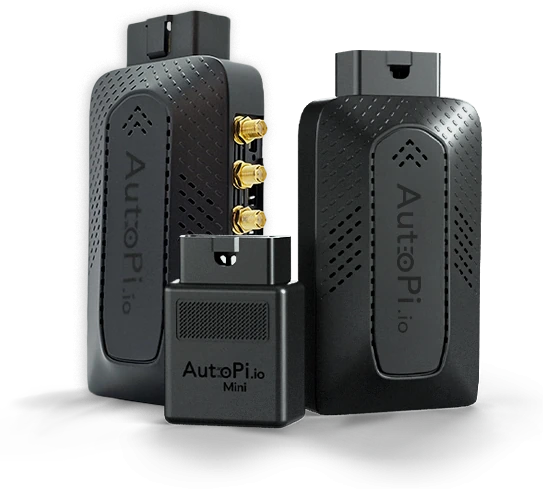
AutoPi CAN-FD Pro

Start here for J1939, CAN FD and vehicle-bus data logging. Confirm the vehicle network, connector and signal definitions.

Explore CAN-FD Pro

// fleet data

AutoPi Mini

For supported EV and OBD fleet data. Check make, model, year and required parameters before ordering.

Check Mini compatibility

// custom edge software

AutoPi TMU CM4

For Docker workloads and custom edge software. Confirm interfaces and any additional hardware needed.

Explore TMU CM4

// delivery scope

Define what your project needs

Included
AutoPi Cloud, plus the selected device's documented hardware and standard software capabilities. Check the supplied accessories and connectivity plan for your chosen configuration.
Configure
Supported signals, sampling, trips, geofences and data delivery for the chosen device. Validate connectors, power, storage and retention limits.
Custom development
Missing signal decoding, external sensor integration and business-system workflows require assessment and an agreed scope.

// your proof of concept

Validate on your vehicles

AutoPi vehicle data devices

We'll help you choose devices to purchase for representative vehicles, then work with you to extract the required data, including reverse engineering where needed. Together, we'll agree the signals, installation, integration work and acceptance criteria before expanding the deployment. Feasibility and scope depend on your vehicles.

Discuss your PoC
// contact

Still have questions?

Get in touch with us - we're ready to answer any and all questions.

// send a message
We aim to reply within one business day.

Or email sales@autopi.io.

* Mandatory fields

Contact our engineers ↑