






















 Cloud Login
// fleet data
AutoPi Mini
Verify supported EV/OBD vehicles and parameters for standard fleet data.
Explore MiniAutoPi TMU CM4 is an embedded Linux telematics unit built for engineering teams that need direct and programmable access to vehicle networks. It interfaces with raw CAN, CAN-FD, J1939, and OBD-II, exposing the full Raspberry Pi CM4 stack with open APIs for custom data acquisition, edge processing, and integration logic.
The device ingests high-frequency bus traffic, timestamps it on-device, and streams or buffers it over 4G/LTE, WiFi, or Ethernet with retry, compression, and rate control. Developers can deploy parsers, watchdogs, and automation scripts using standard Linux tooling, backed by secure boot, device certificates, and TLS transport.
Integrate with existing systems via REST, MQTT, and webhooks; manage OTA updates, parser versions, and configuration profiles from a unified interface. Suitable for mixed ICE/EV fleets, prototyping, test benches, and production-grade telematics deployments requiring transparency down to every frame and timestamp.
Contact us
Build advanced telematics systems on top of the AutoPi TMU CM4. An embedded Linux platform with direct access to vehicle networks, programmable edge logic, and modular expansion options for demanding automotive applications.

The TMU CM4 exposes the full Raspberry Pi Compute Module 4 environment, enabling developers to deploy parsers, automation, and data pipelines in standard Linux tooling. Dual CAN/CAN-FD interfaces provide direct access to OBD-II, J1939, and proprietary vehicle networks, while optional add-on boards extend the system with additional CAN channels or custom interfaces.
Integrated 4G/LTE with GNSS offers worldwide connectivity and positioning, including automatic fallback, buffering, and retry logic for noisy environments. The platform supports encrypted transport via TLS with device certificates, ensuring predictable and secure data flow whether connected to your backend or the AutoPi Cloud.
At its core is the Broadcom BCM2711 Quad-core Cortex-A72, delivering sufficient compute for edge analytics, compression, event detection, and protocol translation. Configurable memory modules provide flexibility for heavier workloads such as CAN-FD logging or high-frequency sensor processing.
The device supports Diagnostics over IP (DoIP), secure boot, and a dedicated hardware security element for credential protection and signed messaging. Certified for automotive deployment (CE/FCC), the TMU CM4 is suited for OEM integrations, retrofit programs, development benches, and large-scale fleet telematics where reliability, auditability, and full network transparency are required.
The AutoPi TMU CM4 integrates essential telematics functions used in engineering, diagnostics, and fleet operations, enabling real-time data access, secure remote control, and predictable device lifecycle management.

Ingest and publish high-frequency CAN/CAN-FD, OBD-II, and J1939 signals with millisecond-level timestamps. Stream data via MQTT or REST with rate control, buffering, and compression to support analytics, anomaly detection, and test-bench workflows.

Deploy OS images, configuration profiles, and custom edge applications remotely. Updates are verified with cryptographic signatures, applied atomically, and logged with device, version, and timestamp metadata for audit and rollback.

Monitor device health, logs, parser versions, and network status in real time. Apply configuration deltas, restart services, and push diagnostics via secure channels, ensuring consistent behavior across test fleets and production deployments.
AutoPi provides an integrated hardware–software stack for engineering-grade telematics. Developers gain direct access to vehicle networks, programmable edge logic, and cloud-based device and data management for building reliable, production-ready telematics systems.

The AutoPi TMU CM4 is an embedded Linux telematics computer with dual CAN/CAN-FD, integrated 4G/LTE + GNSS, and full access to the Raspberry Pi CM4 environment. Developers can deploy custom parsers, automation scripts, and protocol bridges directly on the device, making it suitable for OEM integrations, test benches, and field deployments.
AutoPi TMU CM4
AutoPi Cloud provides secure device provisioning, telemetry ingestion, OTA updates, configuration management, and operational monitoring. The platform exposes APIs, MQTT endpoints, and webhooks, enabling integration with 3rd-party systems or custom backend applications. All device actions and dataflows are logged with version, user, and timestamp metadata for audit and control.
AutoPi CloudKey operational metrics that reflect how AutoPi hardware and cloud infrastructure perform in production environments. These numbers highlight improvements in connectivity, update speed, developer throughput, and high-volume data handling.
Projects report up to 70% higher network uptime using LTE fallback, buffered uploads, and adaptive retry logic for CAN and GNSS data.
Differential updates and compressed payloads reduce OTA deployment times by ~50%, improving rollout velocity across test fleets and production units.
Open APIs, Linux tooling, and protocol transparency drive high adoption among engineering teams building custom telematics and data pipelines.
Capable of processing and buffering more than 5GB/hr of high-frequency CAN-FD, sensor, and GNSS data for downstream analytics and diagnostics.
AutoPi provides an engineering-grade platform built for OEMs, integrators, and R&D teams developing telematics and connected-vehicle solutions. Our hardware delivers transparent access to CAN, CAN-FD, J1939, and OBD-II networks, while our cloud tools enable secure device lifecycle management, OTA deployments, parser versioning, and telemetry ingestion at scale. Whether you are validating new EV systems, building diagnostics tools, or deploying fleet-wide telematics infrastructure, AutoPi gives you the control, flexibility, and observability needed to move from prototype to production with confidence.

// your proof of concept
Let's find the right hardware for your vehicles, validate the data you need and plan the integration together.
// fleet data
Verify supported EV/OBD vehicles and parameters for standard fleet data.
Explore Mini// vehicle-bus logging
Evaluate J1939, CAN FD and vehicle-bus data logging.
Explore CAN-FD Pro// custom edge software
Develop Docker workloads and custom edge software.
Explore TMU CM4Confirm vehicle power, connectors, adapters and any required external sensors. An accessible connector does not guarantee that every requested signal is available.
Compare device capabilities// project scope
// from testing to rollout
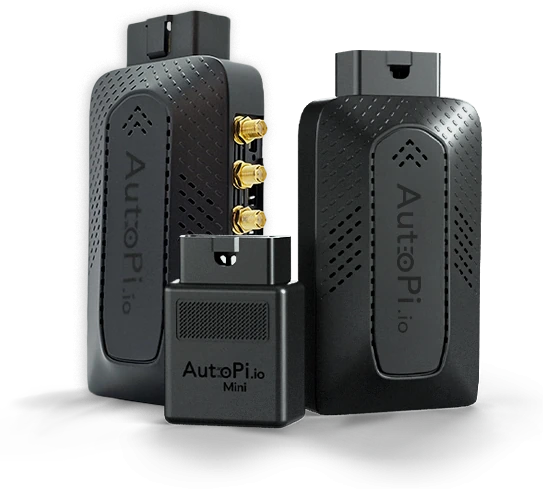
We'll help you choose devices to purchase for representative vehicles, then work with you to extract the data you need, including reverse engineering where needed. Together, we'll agree the scope and acceptance criteria, validate the captured signals and integration, then decide on rollout.
Discuss your PoCGet in touch with us - we're ready to answer any and all questions.