






















 Cloud Login
// fleet data
AutoPi Mini
Verify supported EV/OBD vehicles and parameters for standard fleet data.
Explore MiniAutoPi Keyless replaces physical keys with hardware-bound, policy-driven credentials enforced at the edge. Access is validated on-device using signed policy manifests. Decisions are deterministic, offline-capable, and fully auditable. Every event is logged with user, VIN, timestamp, and CAN-level outcome.
Hardware-rooted certificates. Replay-resistant command channels.
Local enforcement. Syncs on reconnect. No cloud dependency per unlock.
ICE + EV. 12 V / 24 V. Mixed fleet support out of the box.
Multiple credential methods. Role, time-window, and geofence scoped.

Access decisions are made on the device, not in the cloud. Policies are delivered as signed, versioned manifests. Vehicle actuation happens over CAN or digital I/O only after local validation passes.
Driver credential
App, RFID, or NFC
On-device policy check
Role, time window, geofence
CAN, I/O actuation
Lock, unlock, immobilize
Hardware-rooted identity
Each device carries a unique certificate. Mutual TLS is negotiated per session; commands are signed and freshness-checked before CAN execution.
Offline-capable enforcement
Signed policy manifests are cached on-device. Access decisions execute without a cloud round-trip. Events buffer locally and sync when connectivity returns.
RBAC with time and geo scoping
Map roles, time windows, and geofence polygons to user identities or groups. Policies push to the edge without requiring vehicle network access during update.
Immutable audit log
Every access event is stamped with user ID, credential method, VIN, CAN-level result, and UTC timestamp. Exportable for compliance and forensics.
From credential issuance to CAN-level actuation, AutoPi Keyless covers every layer of the access control stack with full integration into your existing fleet management and identity infrastructure.
EV-native access control
The AutoPi device reads EV-specific OEM parameters including state of charge, charging state, and HV contactor status and feeds them into access and immobilization logic. Restrict access while charging, block drive-off on low battery, or alert when an EV departs a charger zone unexpectedly.
Cryptographic command chain
Commands travel over mTLS, are signed at source, and verified on-device before any vehicle signal is actuated. No unsigned command can trigger a lock, unlock, or immobilize action regardless of network path.
SSO and tenant isolation
Connect your identity provider via OIDC or SAML. Each tenant sees only their own fleet, users, and audit data. API rate limits and per-tenant RBAC keep large multi-customer deployments predictable.


Correlated alert logic
Alerts trigger from correlated access and telemetry, not just raw thresholds. Fire on unlocks outside an allowed time window, starts outside a geofence, or movement with no associated keyless event. Forward via email, webhook, or your incident management tooling.
GPS and access correlation
Position, speed, ignition, and door status are fused with keyless events into full session records. Immediately distinguish authorized from unauthorized movement and feed trip and dwell metrics into billing or safety models via API.
OTA policy and firmware management
Keyless policies, parser versions, and firmware updates are all first-class objects in AutoPi Cloud. Roll out changes, rotate certificates, and monitor health fleet-wide from a single console or API, no workshop visits needed.
AutoPi Keyless is API-first. Feed events into your dispatch, ERP, billing, or incident tooling without replacing what you already operate.
Full programmatic control: issue or revoke credentials, query access logs, push policy updates, and retrieve telemetry. Rate-limited per tenant with API key or OAuth 2.0.
Subscribe to per-device or per-fleet topic streams for real-time access events, telemetry, and state changes. Low-latency, ideal for dashboards and dispatch systems.
Push keyless events directly to your endpoint on unlock, lock, failed attempt, or policy violation. HMAC-signed payloads verify origin. Retry logic handles transient outages.
Federate with your corporate IdP. Users log in once; access is scoped per tenant and role mapping is configured in AutoPi Cloud without touching device firmware.
Export access logs, trip records, and audit trails on a schedule for billing, compliance, or archival. CSV or JSON output to object storage or your own endpoint.
Ready to integrate?
Talk to our team about fleet size, vehicle types, and integration requirements. We will scope the right setup for your operation.
// your proof of concept
Let's find the right hardware for your vehicles, validate the data you need and plan the integration together.
// fleet data
Verify supported EV/OBD vehicles and parameters for standard fleet data.
Explore Mini// vehicle-bus logging
Evaluate J1939, CAN FD and vehicle-bus data logging.
Explore CAN-FD Pro// custom edge software
Develop Docker workloads and custom edge software.
Explore TMU CM4Confirm vehicle power, connectors, adapters and any required external sensors. An accessible connector does not guarantee that every requested signal is available.
Compare device capabilities// project scope
// from testing to rollout
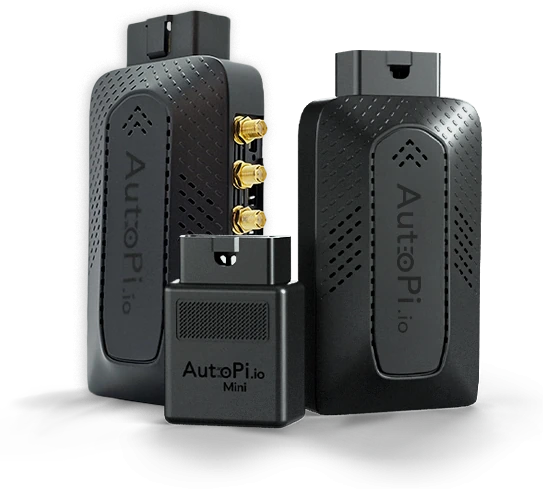
We'll help you choose devices to purchase for representative vehicles, then work with you to extract the data you need, including reverse engineering where needed. Together, we'll agree the scope and acceptance criteria, validate the captured signals and integration, then decide on rollout.
Discuss your PoCGet in touch with us - we're ready to answer any and all questions.