






















 Cloud Login

Need a simple, practical intro to intelligent vehicle technology?
Connected vehicles are vehicles where data from the vehicle can be collected, processed and used outside the vehicle itself. The important part is not only the connection. The important part is what data is collected, how it is handled and whether the system can be maintained safely over time.
Intelligent vehicle technology is about adding sensing, compute, connectivity and software management to vehicles.
Some of this is built into new vehicles from the factory.
Some of it can also be added to existing vehicles with telematics hardware and a cloud platform.
In practical terms, an intelligent vehicle is easier to monitor, configure and maintain.
It can send telemetry, report faults, receive configuration changes and support better planning for service and operations.
For fleet operators, the value is usually better uptime, better diagnostics and more reliable data.
For engineers, the value is access to real vehicle behaviour outside the test bench.
This article explains the main building blocks behind intelligent cars and how telematics can be used to add connected features to existing vehicles without changing the vehicle’s core control systems.
What is an intelligent car?
An intelligent car is a vehicle that uses sensors, software, connectivity and vehicle data to support monitoring, automation, diagnostics and integration with external systems.
This can include driver-facing features such as navigation, adaptive cruise control, parking assistance and infotainment.
But the more important layer is often less visible.
Vehicle telemetry, ECU data, diagnostics, software updates and secure communication with backend systems.
A useful way to look at it is this:
A normal vehicle performs its functions locally.
An intelligent vehicle can also report what is happening, receive controlled updates and become part of a larger operational system.
Typical examples include live vehicle tracking, fault-code reporting, driver behaviour data, EV battery monitoring, route optimization, remote configuration and maintenance alerts.
These functions are relevant for fleet management, car sharing, service operations and development work.
Intelligent vehicle technology is also part of larger topics such as Smart Mobility and Smart Cities, where vehicles are connected to traffic systems, charging networks, logistics platforms and other infrastructure.
The high-visibility features, such as large displays or automated parking, are only the surface.
The real foundation is reliable sensing, vehicle network access, secure connectivity and a controlled software lifecycle.
Smart car technology: core components
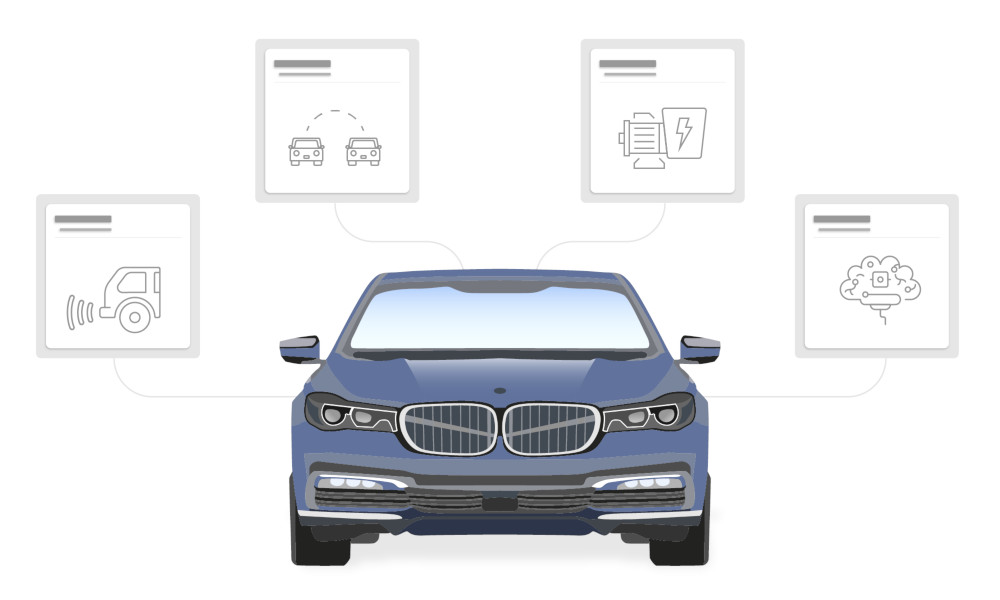
Intelligent vehicles are built from several layers.
Sensors collect data.
ECUs and domain controllers process it.
Vehicle networks move data between systems.
Connectivity sends selected data to a backend.
Cloud software handles dashboards, alerts, reports, configuration and sometimes updates.
The vehicle still needs to make safety-critical decisions locally.
Braking, steering and powertrain control cannot depend on a cloud connection.
The cloud is mainly used for monitoring, analytics, configuration, reporting and long-term data storage.
Typical components include cameras, radar, GNSS, accelerometers, ECUs, CAN, CAN FD, Ethernet, cellular modems, Wi-Fi, Bluetooth and cloud APIs.
As more functions become connected, automotive cybersecurity becomes part of the design, not something added at the end.
This is where a platform like AutoPi fits.
AutoPi can be used as a telematics and edge-compute layer that reads vehicle data, applies local logic and forwards selected signals to the cloud.
That makes it possible to build repeatable workflows for telemetry, diagnostics, alerts and reporting across a fleet.
The goal is not to take over safety-critical vehicle functions.
The goal is to collect useful data, manage devices and integrate vehicles with business systems in a controlled way.

Intelligent car architecture: from sensors to cloud
A connected vehicle architecture can be split into a few practical layers.
The sensors and actuators are closest to the vehicle.
ECUs and domain controllers handle real-time control.
Gateways and networks decide how data moves between domains.
Connectivity links the vehicle to cloud systems.
For retrofits, the telematics unit is usually placed as an additional layer.
It reads available vehicle data through OBD-II, CAN, CAN FD or other interfaces, then sends selected data to the backend.
This makes it possible to add monitoring and reporting without redesigning the original vehicle electronics.
| Layer | What it includes | Why it matters |
|---|---|---|
| Sensing and actuation | Cameras, radar, GNSS, IMU, temperature, current, wheel speed | Measures vehicle state and surroundings. |
| ECUs and controllers | Powertrain, body, chassis, ADAS and domain controllers | Handles real-time vehicle functions. |
| Gateway and networks | CAN, CAN FD, LIN, Ethernet and gateway rules | Controls how data moves between systems. |
| Connectivity and cloud | 4G/5G, Wi-Fi, APIs, storage, dashboards and alerts | Makes vehicle data available for monitoring and integration. |
A good architecture does not send everything to the cloud by default.
It filters and processes data close to the vehicle where possible.
This keeps data volume under control and makes the system easier to operate.
Connectivity: GNSS, Wi-Fi, Bluetooth, 4G/5G and V2X readiness
Connectivity decides how the vehicle communicates with external systems.
GNSS provides position, speed and time.
Wi-Fi and Bluetooth are often used for provisioning, pairing, local access or short-range data transfer.
Cellular connectivity is used for telemetry, remote diagnostics, commands and backend communication.
V2X is often mentioned in smart vehicle discussions, but it depends heavily on infrastructure, regulations and vehicle support.
For most fleet and retrofit projects today, reliable 4G or 5G connectivity is the more practical starting point.
| Method | Typical use | Practical note |
|---|---|---|
| GNSS | Position, speed, time and route history | Urban areas and tunnels can reduce accuracy. |
| Wi-Fi and Bluetooth | Provisioning, pairing and local access | Pairing and credentials should be controlled. |
| 4G or 5G | Telemetry, diagnostics, commands and cloud sync | Buffer data when coverage is poor. |
| V2X readiness | Vehicle-to-vehicle and vehicle-to-infrastructure communication | Depends on local infrastructure and regulation. |
Connectivity should be designed together with security.
Transport should be encrypted, credentials should be managed, access should be role-based, and control commands should be separated from normal telemetry where possible.
OTA updates and the software-defined vehicle
Over-the-air updates are one of the most important parts of connected vehicle operation.
They allow software, configuration and sometimes calibration changes to be distributed without physically accessing every vehicle.
OTA should be treated as a controlled process, not just a file transfer.
A mature setup includes staged rollout, version tracking, signed updates, rollback support and monitoring of success and failure.
This is especially important when vehicles are distributed across many locations.
Cybersecurity and compliance
Security must be handled at both vehicle and cloud level.
On the vehicle, this means protected interfaces, network separation, secure storage and controlled access to local diagnostics.
In the cloud, it means encryption, access roles, audit logs and clear operational procedures.
For fleet operators and B2B customers, this also affects procurement and compliance.
It should be possible to explain who can access vehicle data, where it is stored, how long it is kept and how updates are approved and rolled back.
A simple look at how smart cars work
The basic loop is straightforward.
Sensors and ECUs produce data.
A gateway or telematics unit collects selected signals.
Some logic runs locally on the vehicle.
Relevant data is sent to the cloud.
The cloud stores, displays and processes the data, and may send back configuration or commands.
If the vehicle loses connectivity, the gateway should buffer data and send it later.
If software is updated, the update should be rolled out in stages and verified.
This keeps safety-critical functions inside the vehicle and uses the cloud for monitoring, analytics and management.
Key elements in a smart vehicle setup include:
- Sensors and cameras: Measure the vehicle state and surroundings.
- ECUs and controllers: Process data and control vehicle functions.
- Vehicle networks: Move data between ECUs, gateways and telematics units.
- Connectivity: Links the vehicle to cloud systems and external services.
- Cloud software: Handles dashboards, alerts, APIs, reporting and configuration.
- OTA update flow: Keeps software and configuration manageable over time.

The AutoPi TMU CM4 can be used as a telematics and edge-compute unit in connected vehicle architectures.
What car has the most smart technology?
This question changes every year and depends on what you value.
One vehicle may lead in driver assistance, another in software updates, another in EV efficiency and another in infotainment or comfort systems.
Instead of ranking individual models, it is more useful to look at what the vehicle architecture supports.
Tesla, Mercedes-Benz, BMW, Audi, Porsche and other high-end manufacturers all use different approaches to software, connectivity, driver assistance and energy management.
Vehicles such as the Tesla Model X, Mercedes-Benz S-Class, Mercedes-Benz EQS, Audi A8, BMW 7 Series and Porsche Taycan are often used as examples because they combine advanced electronics, software, connectivity and driver assistance.
But the exact feature set depends on model year, region, trim level and software version.
If you are comparing vehicles or planning a retrofit project, focus less on the model name and more on the layers that can be maintained over time: sensing, connectivity, OTA capability, diagnostics, security and data access.
What makes a car intelligent in practice
A vehicle becomes practically intelligent when it is measurable, connected, secure and maintainable.
The table below shows what to check when evaluating vehicles or retrofit platforms.
| Layer | What to look for | Why it matters |
|---|---|---|
| Sensing and compute | Reliable sensors, GNSS, vehicle data access and enough compute headroom | Provides usable data and room for future functions. |
| Connectivity | 4G/5G modem, Wi-Fi, secure pairing and cloud connection | Enables telemetry, diagnostics and backend integration. |
| Software lifecycle | OTA, version control, rollback and monitoring | Makes updates safer and more predictable. |
| Security and governance | Access control, encrypted transport, audit logs and data rules | Protects vehicle systems and customer data. |
This type of comparison is more useful than a feature checklist.
It tells you whether the platform can be operated, secured and improved over time.
How to upgrade car systems with telematics
Telematics is a practical way to add intelligent functions to existing vehicles.
A telematics unit such as the AutoPi Telematics Unit can connect to OBD-II, CAN or other vehicle interfaces and send selected data to AutoPi Cloud.
This can support tracking, diagnostics, driver behaviour analysis, energy monitoring, alerts and integration with other systems.
The important part is to define the use case first.
Do not start by logging everything.
Start by deciding which problem the data should solve.
A practical rollout normally looks like this:
- Define requirements: Decide whether the goal is tracking, diagnostics, driver behaviour, EV data, machine utilization or another specific use case.
- Select and install the telematics unit: Choose hardware that supports the required vehicle interface, such as OBD-II, CAN, CAN FD or J1939.
- Verify installation: Check power, GNSS, cellular connection and whether the expected vehicle signals are available.
- Configure data and alerts: Select the signals that matter, configure dashboards and set thresholds for useful alerts.
- Test on a small pilot: Validate the data on a few vehicles before scaling to the full fleet.
- Operate and maintain: Keep firmware updated, monitor connectivity, review alerts and adjust the setup when the fleet or use case changes.
Disclaimer: Telematics upgrades are not always plug-and-play. Vehicle data availability depends on model, year, configuration and network access. Always validate the setup on the actual vehicle before deploying at scale.
A structured rollout allows you to add connected functionality while keeping safety-critical control inside the vehicle and maintaining clear ownership of data, configuration and access.


